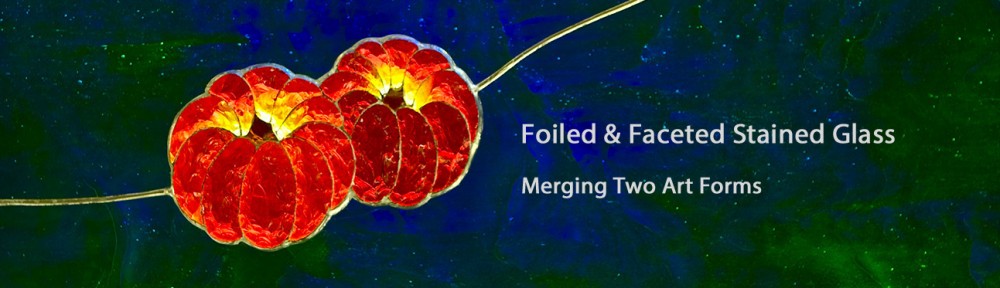
Since the only way you can evaluate my work is through the photographs, here presented, I will describe how they were produced. I want to emphasize that my intent throughout has been to portray the panels in a manner that is as close as possible to what an observer would see when viewing them.
I should note that I am not a professional photographer and, unfortunately, the best location available to me to photograph my panels is a large picture window ( with a SE exposure ) with a background of grass and trees which is less than optimal. I used a Canon Rebel XTi digital camera with a Canon EF 24 – 70 mm 1:2.8 lens. After placing the images into iPhoto, I straightened and cropped the images to include only the stained glass, excluding the frame. The most significant problem that I faced is that my favorite faceted glass ( yellow-orange-red ) is often significantly brighter with more highlights than the the background glass which often resulted in images where the faceted glass was overexposed and the background glass was under exposed. When this was an issue I placed the photographs into Adobe Photoshop Elements 10 and altered the background and faceted glass independently, as I felt appropriate.
I am also using a High Dynamic Range ( HDR ) photography ( Photomatrix ) program that fuses under, normally and over exposed images of the same subject which allows a wider range of contrast to be expressed in a single photograph than can be achieved with standard digital photography.
It is also important to note that even the best and most representative photograph can only record a single instant in time while stained glass is constantly changing in response to changes in the intensity, angle and color temperature of the sunlight. ( see post on color ) I am afraid that the only way to meaningfully show the full dynamic nature of the my panels and many other stained glass works would be to utilize some form of time lapse photography.